ALLosteric drug discovery
for ION channels.

We develop predictive computational models to guide drug design, linking target engagement to effects in the body.

Ion channel target
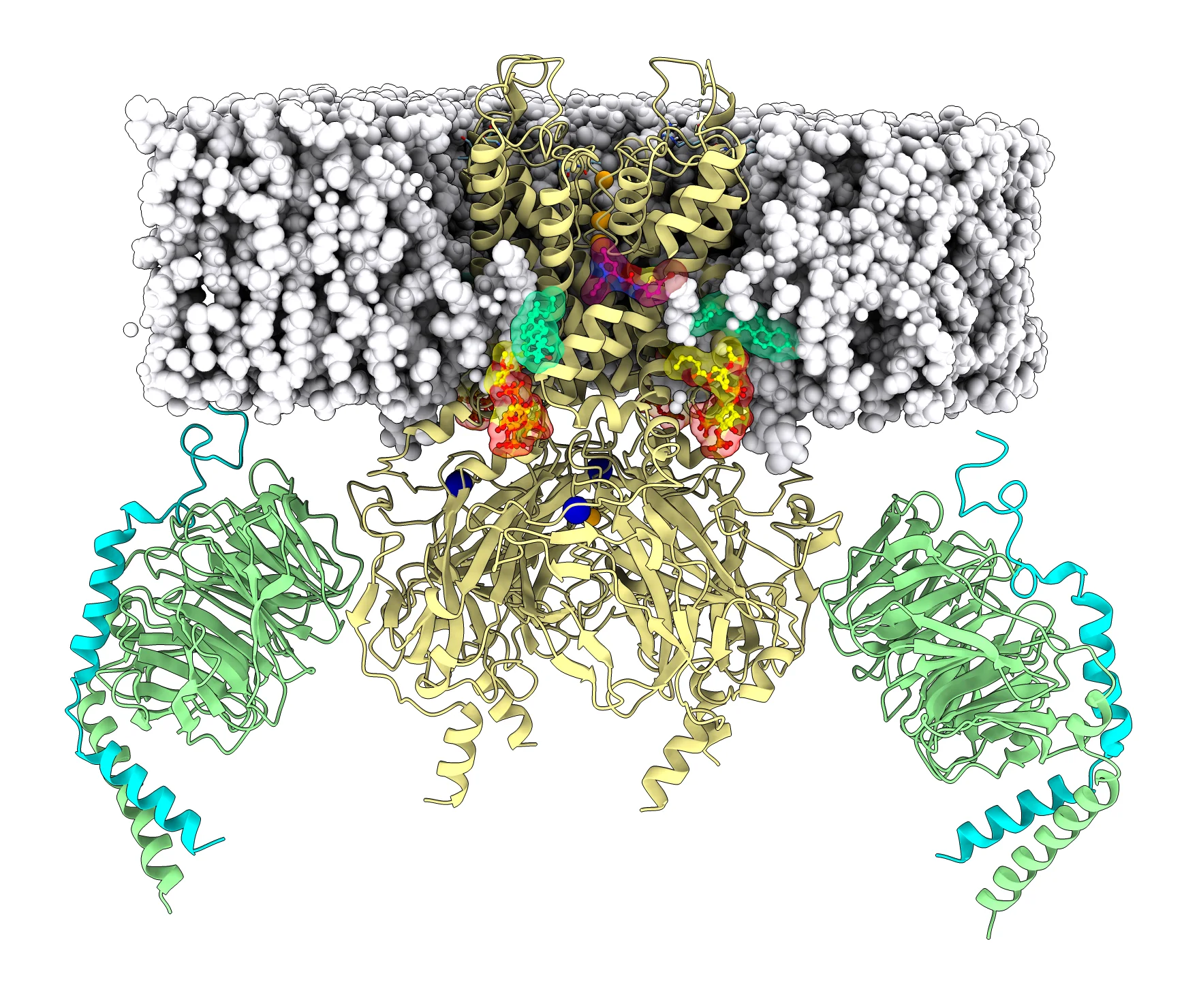
Active-state cryo-EM structure of GIRK potassium channel embedded in lipid bilayer Selectivity Filter & Pore 1 PIP₂ Site 2 2 Allosteric Modulator 3 Gβγ 4 4 Cholesterol 5 5 Na⁺ Ions 6

Active-state cryo-EM structure of GIRK channel in native membrane with six regulatory hotspots. Click any site directly on the structure or use the tabs above to explore each mechanism.

From design to licensed assets.

Drug design

Validated, predictive computational models.

R&D and licensing

Biological validation and asset development.

Indication-focused spinouts

Epilepsy · Pain & addiction · Cardiology · Cancer

Our Approach

Dynamic structure-based allosteric drug design

Our first application: GIRK channels. We integrate active-state ion-channel structures with computational drug design, medicinal chemistry and functional testing to discover subtype-selective allosteric modulators.
01 · Foundation

Three Decades of NIH Research

Built on research into how G proteins and PIP₂ regulate ion channels, supported by more than three decades of continuous NIH funding.

Long-term academic foundation
02 · Resolution

Active-State Cryo-EM Structures

PIP₂-bound cryo-EM structures reveal allosteric binding sites and guide the design of compounds that selectively control channel activity.

State-dependent pocket discovery
03 · Capabilities

Transatlantic Team Integration

Our transatlantic teams integrate computational drug design and medicinal chemistry with electrophysiology and preclinical testing.

Cambridge, MA & Athens, Greece
04 · Applications

Targeted Pipeline & Biomarkers

Advancing selective GIRK1/2 activators for drug-resistant epilepsy, with programmes in pain, addiction, atrial fibrillation and ion-channel cancer biomarkers.

CNS, cardiac & oncology profiles

Core Capabilities

Structure → Simulation → Chemistry → Pharmacology

Connecting cryo-EM structural resolution with molecular dynamics, medicinal chemistry and electrophysiology to guide subtype-selective allosteric drug design.
Structure Structural Biology
Cryo-EM active-state tetrameric channel structure at 90 degree views

Cryo-EM Structures

We resolve ion channels in active conformations to understand how regulatory sites and ligand interactions influence channel opening. These structural insights provide the foundation for computational modelling and experimental investigation of allosteric mechanisms.

Simulation Computational Chemistry
Computational gating molecular dynamics and pore energy landscape

Drug Design

Structure-guided screening and fragment mapping identify promising chemical starting points. Free-energy perturbation evaluates relative binding affinity, while gating molecular dynamics assesses predicted effects on drug efficacy.

Chemistry Medicinal Chemistry
Medicinal chemistry synthesis and lead optimization fume hood

Medicinal Chemistry

We translate structural and computational insights into compounds for experimental testing. Iterative design and synthesis refine potency and subtype selectivity alongside metabolic stability, solubility and other properties needed for drug development.

Pharmacology in vitro & in vivo
Patch clamp electrophysiology recording on neuronal cell

Function, Pathophysiology

We combine functional screening and electrophysiology to characterise compound activity, establish subtype selectivity and investigate how channel modulation influences cellular excitability. Studies in disease-relevant models connect these effects with underlying pathophysiology.

6-Stage Iterative Discovery Cycle

A Defined Discovery Cascade

Iterative Feedback Loop Experimental results continuously guide the next design cycle.

Channel Gating & Physiology

Our First Application: Epilepsy

We are applying our discovery approach to GIRK potassium channels, regulated by G-protein βγ subunits and the membrane lipid PIP₂. Structural differences between GIRK assemblies guide our design of subtype-selective allosteric modulators. G-protein-gated inwardly rectifying potassium channels, or GIRK channels, contribute to inhibitory signalling in the nervous system and to heart-rate regulation. Their subunit composition influences where they act, how they respond to cellular signals and how they interact with drugs.

GIRK1/2 Mechanism

Tap to play video

Mechanism of Action: GIRK activation increases potassium conductance, helping stabilise membrane potential and reduce neuronal excitability.

Subunit Heterogeneity

Targeting Heterotetrameric GIRK Assemblies

GIRK channels operate as heterotetrameric and homotetrameric assemblies across neuronal and cardiac tissues, with distinct allosteric interfaces.
GIRK1/2 Heterotetramer

Distribution

Widely expressed in the central nervous system, including the hippocampus and cortex.

Therapeutic Relevance

Epilepsy and pain

GIRK2 Homotetramer

Distribution

Present in subsets of midbrain dopaminergic neurons.

Therapeutic Relevance

Reward signalling and addiction research

GIRK1/4 Cardiac heterotetramer

Distribution

Prominent in atrial and cardiac pacemaker tissue.

Therapeutic Relevance

Atrial fibrillation research

Broader Heteromeric Assemblies: Other combinations, including GIRK2/3 & GIRK1/3, add further functional diversity and are relevant to our broader research.

Therapeutic Scope

Therapeutic Reach Across 4 Disease Areas

Selective allosteric modulation of GIRK channels offers therapeutic opportunities across neurological disorders, cardiovascular conditions.

Targeted Programmes

Discovery Pipeline

Advancing selective allosteric modulators for drug-resistant epilepsy, with early-stage programmes in pain, addiction, atrial fibrillation and ion-channel cancer biomarkers.

Drug-resistant epilepsy

GIRK1/2

Lead Asset
Target Validation
Discovery
Lead Optimization Current
Candidate Selection
Preclinical

Neuropathic and post-surgical pain

GIRK1/2 & GIRK2 and GIRK2/3

Target Validation
Discovery Current
Lead Optimization
Candidate Selection
Preclinical

Substance use disorders

GIRK2 and GIRK2/3

Target Validation
Discovery Current
Lead Optimization
Candidate Selection
Preclinical

Atrial fibrillation & cardiac safety

GIRK1/4

Target Validation
Discovery Current
Lead Optimization
Candidate Selection
Preclinical

Cancer diagnostics (Breast cancer)

GIRK1

Target Validation
Discovery
Lead Optimization
Candidate Selection
Preclinical Current
Approach Extensibility

Beyond GIRK

We are evaluating opportunities to apply our approach to other PIP₂-regulated ion-channel families as suitable structural and biological evidence becomes available.

Collaboration

Interested in a programme or scientific collaboration?

We collaborate with academic institutions, biotechnology partners and investors.

Programmes are developed through our iterative discovery cascade, from cryo-EM structural resolution to lead optimisation and preclinical candidate selection.

Founders

Diomedes E. Logothetis, PhD

Diomedes E. Logothetis, PhD

Co-Founder & Acting CEO

Northeastern University, Prof. Emeritus

Diomedes’s research has helped establish how G proteins and PIP₂ regulate ion channels. His laboratory’s work on GIRK pharmacology, gating molecular dynamics and active-state structures provides the scientific foundation for Allion’s discovery platform.

Stelios M. Smirnakis, MD, PhD

Stelios M. Smirnakis, MD, PhD

Co-Founder

Brigham and Women’s Hospital and Harvard Medical School

Stelios is a neurologist and neuroscientist studying how changes in neural circuits contribute to neurological disease. His expertise in epilepsy and experimental neurophysiology supports the evaluation of GIRK modulators in disease-relevant models.

Publications

1987
Nature Landmark

The βγ subunits of GTP-binding proteins activate the muscarinic K⁺ channel in heart

Logothetis DE, Kurachi Y, Galper J, Neer EJ, Clapham DE · Nature 325(6102):321–326 (1987)

This study demonstrated that G-protein βγ subunits activate the cardiac muscarinic potassium channel directly. The discovery established a fundamental mechanism linking receptor signalling to ion-channel activity and laid the groundwork for understanding GIRK regulation.
1998
PNAS Landmark
This study established that activation of cardiac GIRK channels by G-protein βγ subunits or intracellular sodium depends on the membrane lipid PIP₂. Depleting or blocking PIP₂ impaired channel activation, while restoring it rescued activity, identifying lipid regulation as a central component of GIRK gating.
2002
Neuron

Alterations in Conserved Kir Channel-PIP₂ Interactions Underlie Channelopathies₂

Lopes CMB, Zhang H, Rohacs T, Jin T, Yang J, Logothetis DE · Neuron 34(6):933–944 (2002)

This study identified conserved residues that support PIP₂-dependent regulation of inwardly rectifying potassium channels. It showed that mutations associated with Andersen and Bartter syndromes weaken channel–PIP₂ interactions, connecting disrupted lipid regulation to inherited disease.
2019
Journal of Biological Chemistry

On the mechanism of GIRK2 channel gating by phosphatidylinositol bisphosphate, sodium, and the Gβγ dimer

Li D, Jin T, Gazgalis D, Cui M, Logothetis DE · J Biol Chem 294(49):18934–18948 (2019)

Using molecular dynamics simulations, this study investigated how PIP₂, sodium ions and Gβγ cooperate to control GIRK2 channel opening. The models revealed distinct movements associated with sodium and Gβγ regulation, linking changes in channel–PIP₂ interactions to opening of the channel’s cytoplasmic and transmembrane gates
2020
Journal of Biological Chemistry Landmark

The small molecule GAT1508 activates brain-specific GIRK1/2 channel heteromers and facilitates conditioned fear extinction in rodents

Xu Y, Cantwell L, Molosh AI, Plant LD, Gazgalis D, Fitz SD, Dustrude ET, Yang Y, Kawano T, Garai S, Noujaim SF, Shekhar A, Logothetis DE, Thakur GA · J Biol Chem 295(11):3614–3634 (2020)

This study characterised GAT1508 as a small-molecule activator selective for neuronal GIRK1/2 over cardiac GIRK1/4 channels, linking its activity to enhanced channel–PIP₂ interactions. GAT1508 also facilitated conditioned fear extinction in rodents, providing preclinical evidence that selective GIRK modulation can influence behaviour.
2026
Journal of Biological Chemistry

Ion Channel Nano-Diagnostics for ER+ Breast Cancer

Gkikas M, Dadiotis E, Zaka M, Aly N, Chan K, Logothetis DE · J Biol Chem, article 113623 (2026)

This study describes gold nanoparticles functionalised with a GAT1508-derived ligand to target GIRK1-associated markers in oestrogen receptor-positive breast cancer cells. Experiments demonstrated optical detection of fixed MCF-7 cells without fluorescent dyes or additional amplification, supporting further investigation of ion-channel-targeted probes for cancer diagnostics.
2026
bioRxiv — Preprint

Asymmetric assembly underlies activation mechanism of neuronal GIRK1/2 channels

Kawano T, Wang L, Chan KW, Zorn A, Parvaiz N, Zaka M, Kissell RC, Villalba-Galea C, Santa-Cruz A, Lu Y, Aly N, Pentikis J, Dadiotis E, Li S, Cui M, Plant LD, Skiniotis G, Logothetis DE · bioRxiv 2026.10.06.756360 (2026)

This preprint investigates how asymmetric subunit assembly underlies the activation of neuronal GIRK1/2 channels. The work connects channel architecture with gating mechanisms, providing a framework for understanding how subunit arrangement influences channel function.
2026
bioRxiv — Preprint

Stoichiometry-dependent gating and structural pharmacology of cardiac GIRK1/4 channels

Wang L, Kawano T, Santa-Cruz A, Parvaiz N, Zorn A, Lu Y, Zaka M, Aly N, Pentikis J, Dadiotis E, Chan KW, Cui M, Plant LD, Logothetis DE, Skiniotis G · bioRxiv 2026.10.06.756879

This preprint investigates how the relative numbers of GIRK1 and GIRK4 subunits within cardiac channels influence gating and pharmacological responses. The work examines the structural basis of these differences, connecting channel composition with function and drug sensitivity.
2026
bioRxiv — Preprint

GAT1508, a selective neuronal GIRK1/2 activator, exhibits superior antiepileptic efficacy and synergizes with cannabidiol

Simhadri J, Zorn A, Wang L, Kawano T, Cordero Ruiz N, Vagiaki L, Parvaiz N, Parvaiz M, Cantwell L, Chan K, Santa Cruz Garcia A, Dadiotis E, Rivera N, Felix W, Thakur GA, Manetsch R, Plant LD, Sidiropoulou K, Cui M, Skiniotis G, Logothetis DE, Smirnakis S · bioRxiv 2026.10.14.758970 (2026)

This preprint reports the antiseizure efficacy of GAT1508, a selective neuronal GIRK1/2 activator, and its synergistic activity with cannabidiol. These findings support further investigation of selective GIRK1/2 activation for epilepsy, both alone and in combination with existing treatments.
Corporate Architecture & Spinout Portfolio

Indication-focused spinout companies.

Assets and intellectual property licensed from ALLION/ICAL to indication-focused spinouts (Spinout LLC → C-Corp. at seed financing / strategic partnership stages) to enable independent capitalization, disease-specific consortia, and tailored clinical progression.

U.S. Parent Company · Cambridge, MA

ALLION Therapeutics, LLC

U.S. Corporate Seat • LabCentral, Cambridge, MA

Owns the platform IP and builds a diversified portfolio of ion-channel therapeutic assets.

Parent Governance & Strategy

  • • Manages ALLION / ICAL intellectual property and corporate strategy
  • • Runs U.S. R&D, biological validation and translational development
  • • Creates and licenses assets to indication-focused spinout companies
LabCentral facility in Cambridge, Massachusetts
United States · Boston / Cambridge

LabCentral · Cambridge, MA

700 Main Street, Cambridge, MA 02139

U.S. R&D Seat

ALLION — R&D + IP Management

U.S. Headquarters • LabCentral • Cambridge, MA

  • • Assay development & protocol design for ALTP high-throughput screening
  • • IP portfolio management, licensing and spinout formation
  • • Corporate strategy, business development and investor relations
Athens Life Tech Park facility in Athens, Greece
Greece · Athens

Athens Life Tech Park (ALTP)

Panepistimiopolis, Ilisia, Athens

Discovery Hub · NKUA

ICAL • Ion Channel Allosteric Ligands

Greek Subsidiary • Athens Life Tech Park (ALTP)

  • • Discovers allosteric activators/inhibitors and optimizes new assets
  • • Research-tool distribution & pharmacological supplies
  • • Provides CRO discovery services to external ion-channel programs
Assets & IP licensed from ALLION to indication-focused spinouts

Spinout LLC → C-Corporation at seed financing / strategic partnerships

Spinout LLC → C-Corp at seed financing Lead Asset

GIRK-E Therapeutics

Epilepsy
Target: GIRK1/2 · Neurodevelopmental epilepsies (e.g., Dravet, Lennox-Gastaut)

Dedicated to drug-resistant and genetic epilepsies. Translating selective GIRK1/2 activators (lead series GAT1508 optimization) into clinical candidates that strengthen inhibitory conductance.

Spinout LLC → C-Corp strategic partners Multi-Indication Pipeline

Additional Programmes

Pain, Addiction, Cardiology & Oncology

Pain + Addiction / Addiction GIRK1/2 • GIRK2; GIRK2/3
AF; Stroke GIRK4 • GIRK1/4 • GIRK2 • GIRK1/2
Breast Cancer – ER+ GIRK1 Biomarkers

Additional assets include for pain and addiction, cardiovascular disease and cancer diagnostics. As these programmes mature, they offer opportunities for indication-focused spinouts and licensing partnerships.

Platform Discovery → Protected Assets → Focused Spinouts → Indication Value
Independent financing · Potential QSBS eligibility

Structure designed to support independent financing and potential QSBS eligibility; tax and legal treatment subject to counsel.

Contact & Inquiries

Connect with our scientific & corporate team.